Daily vs. weekly vs. monthly collection: what it actually changes

Collection frequency does not change what you repay on a merchant cash advance. A $30,000 advance at a 1.30 factor costs $39,000 whether it is collected daily, weekly or monthly. What frequency changes is the number of separate withdrawals, the size of each one, and how much room you have when takings dip for a fortnight.
Those are the things that decide whether a payment schedule is comfortable or corrosive. So it is worth understanding precisely, because the sales conversation usually starts in the wrong place — with the payment amount, as though a smaller number were automatically a better one.
What frequency does not change
Start with the part that is fixed. All three schedules below repay the same $39,000.
| Daily collection | Weekly collection | Monthly collection | |
|---|---|---|---|
| Advance | $30,000 | $30,000 | $30,000 |
| Factor rate | 1.30 | 1.30 | 1.30 |
| Total repayment | $39,000 | $39,000 | $39,000 |
| Cost of capital | $9,000 | $9,000 | $9,000 |
| Collection dates (over ~6 months) | ~132 business days | 26 weeks | 6 months |
| Payment per date | about $295 | $1,500 | $6,500 |
| Withdrawals in a normal month | about 22 | 4 or 5 | 1 |
The factor rate sets the total. The schedule only divides it. Any offer that appears cheaper at a different frequency is either a different total, a different term, or a different fee list — not a cheaper way of collecting the same thing.
What frequency does change
Three things, and they matter more than the payment amount.
How many chances there are for a pull to fail. Twenty-two withdrawals a month is twenty-two opportunities for a payment to land on a day the account is short. One withdrawal a month is one. That cuts both ways: a failed daily pull is small and usually recoverable, while a failed monthly pull is a much bigger hole and a much worse conversation.
How deep any single pull cuts. $295 out of a Tuesday balance is a detail. $6,500 out of the same account is the difference between making payroll and not.
How the schedule meets your revenue. This is the part that actually decides the fit. Two businesses repaying the same $39,000 can have completely different experiences depending on whether money arrives every afternoon by card or once a month on a retainer.
The illustration below shows one soft fortnight in a business with a $3,000 opening balance, $900 a business day in card takings and $300 a day in fixed costs:
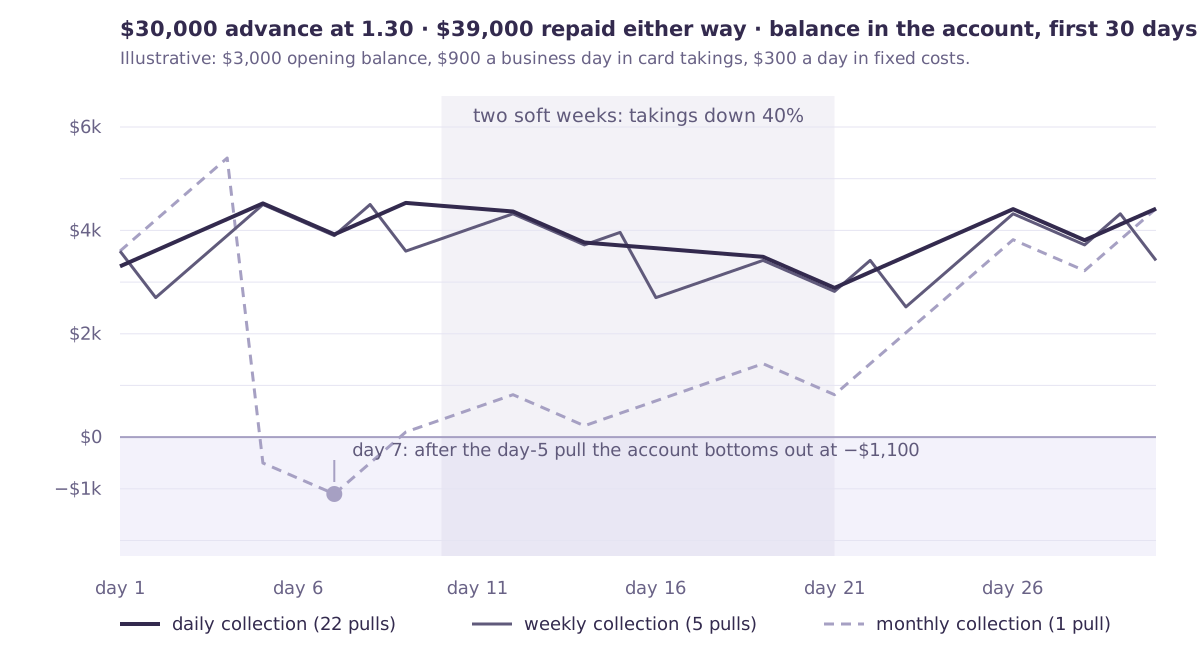
Read honestly, that chart does not say one schedule wins. It says the single monthly pull is the deepest hole — it took that account below zero by day 7 while the daily schedule never fell below about $2,900 — and the daily schedule is the busiest, with 22 draws that leave the account permanently slimmer than its headline balance suggests. Weekly sits between them.
A business with steady card takings can carry a daily pull easily. A business paid on retainer, or on net-30 invoices, often cannot: the money arrives mid-month, but the collection does not wait for it.
Matching the schedule to how your money lands
| If your money arrives… | Collection that usually fits | Why |
|---|---|---|
| Every day, in card or cash takings | Daily (business days) | The pull tracks the takings, so the proportion stays roughly steady |
| Weekly, with payroll cycles | Weekly | Same rhythm as the money, one decision per week |
| Monthly, on retainers or contracts | Monthly | Fewer, larger pulls instead of 22 small ones against an empty account |
| Seasonally, in bursts | Percentage of receipts, or a reconciliation clause | The payment falls in a slow month instead of draining the buffer |
| In large, irregular invoices | Weekly, with a buffer | Monthly lumps and net-45 customers do not line up |
If your agreement offers a percentage-of-receipts structure or a periodic reconciliation, that is usually the closest fit for a business whose revenue moves — it converts a fixed obligation into one that follows the takings. Ask for it explicitly, because it is not always offered unless requested.
The four questions to ask in writing
Before you sign, get answers to these in the documents rather than on a call:
- Can the collection amount re-set if revenue falls? Look for a reconciliation or true-up clause, how often it runs, and what evidence you have to supply.
- What does a missed pull trigger? A returned-payment fee is one thing. An event of default that accelerates the balance is another. Read the paragraph, not the summary.
- Is there a reconciliation step at all? If the amount is fixed for the whole term, understand that a slow month does not reduce it.
- Can the frequency change later, and what does it cost? Some agreements allow it without re-underwriting; others treat it as a new deal.
Two follow-ups worth adding, because they come up later rather than at signing: whether an early payoff is credited against the total, and how much notice you get before a pull increases.
Where Falcon fits
Falcon merchant cash advances run from $5,000 to $5,000,000 with terms of 3 to 18 months, and funding is typically same-day after approval. Requirements are 3+ months in business, $10K+ monthly revenue and an active business bank account. Collection frequency and the remittance terms that apply to a specific file are set in the agreement, so ask for them in writing — that is the whole point of this article.
If your revenue is uneven, compare the schedule against a business line of credit before you commit to a fixed daily pull.
Get Funding Today
If you want a straight answer on what a specific amount would cost you, start an application. You can also review merchant cash advance terms or size a payment with the loan calculator. Falcon Equity Group has been in business 15 years, has helped 300+ businesses and deployed $100M+, with funding from $5,000 to $20M and many products funding within 24–48 hours of approval.
This article is for general information only and is not financial, legal or tax advice. Figures shown are illustrative examples, not offers or quotes. All funding is subject to approval, and approval is not guaranteed.
Frequently asked questions
Does paying weekly instead of daily cost less?
No. The total repaid is set by the advance amount and the factor rate, not the schedule. On a $30,000 advance at 1.30 the total is $39,000 whether it is collected daily, weekly or monthly. A schedule that spreads the same total over fewer, larger payments does not reduce the cost, and an early payoff only saves money if your agreement credits it.
How many withdrawals does a daily collection actually make?
About 22 in a normal month, because daily collection usually runs on business days only. A weekly collection makes four or five, and a monthly collection makes one. The amount per withdrawal is the total repayment divided by the number of collection dates, so fewer dates means a larger single hit.
Which collection schedule is best for a seasonal business?
One that can move with revenue. If the agreement has a reconciliation or true-up step, or a payment that is a percentage of receipts, a slow season reduces the pull instead of draining the buffer. If it is fixed, map the payment against your worst month before you sign, not your average month.
What happens if a collection fails?
Read that paragraph before signing. The common outcomes are a returned-payment fee, a re-presentment a few days later, and in some agreements an event of default that can accelerate the balance. The wording differs a lot between funders, which is why it is worth comparing line by line rather than asking on a call.
Can I change the schedule after funding?
Sometimes, and usually only if the agreement allows it. Ask whether frequency can be changed without re-underwriting, whether a change carries a fee, and whether it resets the term. A funder who can answer that in writing before you sign is telling you something useful about how the relationship will run.