How to compare three invoice factoring quotes in one spreadsheet

To compare invoice factoring quotes, divide the total fee by the cash you actually receive, then annualise it over the days the money is outstanding. The headline rate hides three things that move the answer more than the rate does: the advance rate, whether the fee accrues per 30 days or is flat, and per-invoice minimums.
Run three quotes through that calculation on the same invoice and the ranking often inverts. The quote with the lowest headline rate is frequently the most expensive money in the pile.
Why the headline rate misleads
A factor quotes a fee percentage on the invoice. You receive the advance, which is that percentage of the invoice minus a holdback. The gap between those two numbers is where the comparison usually goes wrong.
Three levers do most of the damage:
- Advance rate. 70% and 95% are ten points apart in headline looks and a third apart in the denominator of your real cost.
- Fee basis. “1.5% per 30 days” and “3% flat for 45 days” are not the same shape. The first keeps charging if the customer pays slowly; the second does not.
- Minimums. A $150 per-invoice fee is trivial on a $40,000 invoice and brutal on a $4,000 one.
None of those numbers is the headline rate. That is why the sheet matters more than the quote.
The five columns that make any quote comparable
For one invoice, with the same expected collection date:
| Column | What goes in it |
|---|---|
| 1. Cash today | Invoice × advance rate, minus any upfront fee |
| 2. Fee at your real collection date | The total fee you would pay if the customer pays on the date you actually expect |
| 3. Days outstanding | Collection date minus funding date. Use your own history, not the factor’s assumption |
| 4. Effective cost | Fee ÷ cash today |
| 5. Annualised cost | Effective cost × (365 ÷ days outstanding) |
Column 4 is the one to look at when the amounts differ. Column 5 is the one to look at when you are comparing factoring with any other kind of funding, because it puts the cost on the same footing as a loan quote.
Worked example: three quotes, one invoice
A $10,000 invoice, customer pays on day 45, three illustrative offers:
| Quote A | Quote B | Quote C | |
|---|---|---|---|
| Headline | 2.0% per 30 days | 3.0% flat for 45 days | 1.5% per 30 days + $150 per invoice |
| Advance rate | 70% | 95% | 75% |
| Cash today | $7,000 | $9,500 | $7,500 |
| Fee at day 45 | $300 | $300 | $375 |
| Effective cost | 4.29% | 3.16% | 5.00% |
| Annualised | 34.8% | 25.6% | 40.6% |
| Recourse | Recourse | Non-recourse | Recourse |
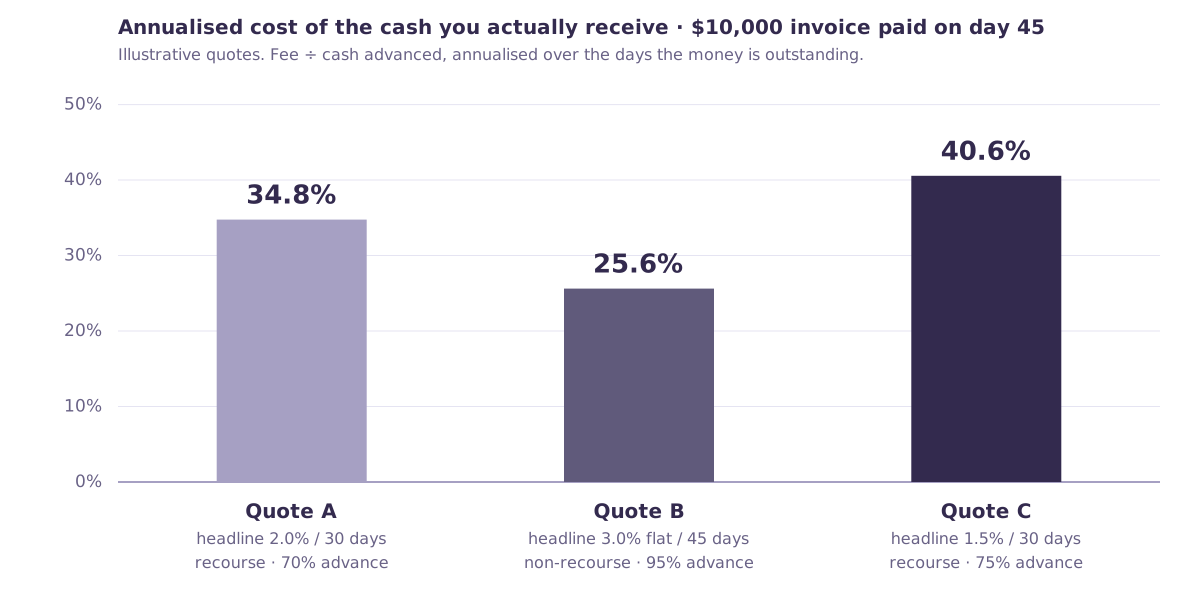
Two things fall out of that table.
The cheapest money here is Quote B, which has the highest headline rate of the three — because it advances 95% of the invoice and charges a flat fee that does not grow while the customer takes 45 days. Quote C has the lowest headline rate and is the most expensive, because a 75% advance plus a $150 per-invoice fee means you are paying $375 to borrow $7,500 for six weeks.
And Quote B is also the non-recourse option, which is the part that should make you slightly suspicious of how neat the example is: usually you pay for risk transfer. Here the flat fee and the high advance rate happen to outweigh it. In your own sheet, price the recourse question separately rather than letting it ride along inside the fee.
What non-recourse actually covers
Non-recourse means the factor absorbs more of the loss when a customer does not pay. It is not insurance. Read the exclusions, because they are where the value is decided:
- Dilution — disputes, short payments, and credits are usually your problem, not the factor’s.
- Customer non-acceptance — if the customer says the work was not delivered, that is typically excluded.
- Concentration limits — non-recourse often turns recourse if one customer is too large a share of the ledger.
- Verification duties — you usually have to notify the customer that the invoice is assigned, and skipping that can void the protection.
Both structures are legitimate. The point is that “non-recourse” on a quote sheet is a headline, and the exclusions are the actual terms.
Six numbers to request from every factor
Ask for these in writing before you open the spreadsheet, because a quote that cannot supply them cannot be compared:
- Fee basis — flat, or accruing per 30 days, and what happens after the expected collection date.
- Advance rate, and the reserve percentage held back.
- How and when the reserve is released, and whether release depends on the customer paying.
- Per-invoice and monthly minimums, plus any minimum volume commitment.
- Recourse or non-recourse, with the exclusions in writing.
- Facility, termination, wire, and verification fees.
Building the sheet in fifteen minutes
- One row per quote, one column set per column above. Do not add columns until the five are filled.
- Hold the invoice and collection date constant across all three. Change one variable at a time.
- Compute column 5 for every quote, including any loan or line of credit you are considering. That is the comparison that matters, and it is the one a fee percentage cannot give you.
- Then, and only then, look at the headline rate. If it disagrees with column 5, column 5 is right.
Where Falcon fits
Falcon invoice factoring runs from $10,000 to $3,000,000 on an ongoing facility, for B2B businesses with creditworthy customers and 3+ months in business. If you want your own quotes put through the five columns, start an application and bring the other offers with you — comparing them side by side is the point. If your invoices are large and infrequent, a business line of credit may price better on the same maths.
Get Funding Today
If you want a straight answer on what a specific amount would cost you, start an application. You can also review invoice factoring terms or size a payment with the loan calculator. Falcon Equity Group has been in business 15 years, has helped 300+ businesses and deployed $100M+, with funding from $5,000 to $20M and many products funding within 24–48 hours of approval.
This article is for general information only and is not financial, legal or tax advice. Figures shown are illustrative examples, not offers or quotes. All funding is subject to approval, and approval is not guaranteed.
Frequently asked questions
Why is a lower factoring rate sometimes more expensive?
Because the rate is charged on the invoice while you only receive the advance. On a $10,000 invoice, a 1.5% fee on a 75% advance is 5.0% of the cash you actually get back; a 3% flat fee on a 95% advance is 3.2%. Annualise both over the days the money is outstanding and the 1.5% quote can be half again as expensive as the 3% one.
What is the right way to compare factoring quotes?
Divide the total fee by the cash you actually receive, then annualise over the days the invoice stays open. Put three quotes through that same calculation on the same invoice and the ranking usually changes. The columns are: cash today, fee at your real collection date, days outstanding, effective cost, and annualised cost.
What does non-recourse mean in factoring?
It means the factor carries more of the risk if your customer does not pay. It almost never covers everything — dilution, disputes, or invoices the customer simply refuses to accept are commonly excluded. Non-recourse is worth paying something for, but read what it excludes before you treat it as insurance.
Which fee numbers should I ask every factor for?
The fee basis (flat or per 30 days), the advance rate, when and how the reserve is released, per-invoice and monthly minimums, whether the arrangement is recourse or non-recourse, and any termination or facility fee. Ask for all six in writing before you compare anything.
How fast does Falcon invoice factoring fund?
Falcon invoice factoring runs from $10,000 to $3,000,000 on an ongoing facility, for B2B businesses with creditworthy customers and 3+ months in business. Funding speed depends on invoice verification, and the terms that apply to a specific file are set out in the agreement.